Work

Publications

Peer-reviewed publications and working papers from across the lab.

18 publications · Most recent first

Interaction-Oriented Instructional Practices Show Promise in Enhancing Overall Performance and Narrowing Racial Achievement Gaps in College Online Courses

Online Learning, 29(3), 211–235

The study links a survey of 369 online instructors with community college enrollment records to examine six types of interaction-oriented teaching practices. Greater use of these practices was associated with course completion, with instructor–student course-management interactions especially promising for narrowing racial gaps. The…

Does professional development for online instruction improve student course outcomes?

The Internet and Higher Education, 65, 100993

Using more than 370,000 online enrollments taught by nearly 900 instructors at one community college, this quasi-experimental study evaluated a 30-hour online-teaching certificate program. It found no statistically significant improvement in persistence or grades. Reviews of subsequent courses found limited incorporation of recommended…

Not ALL Delay Is Procrastination: Analyzing Subpatterns of Academic Delayers in Online Learning

Proceedings of the 15th International Learning Analytics and Knowledge Conference

Using Canvas data from three online undergraduate chemistry courses at a four-year public university, the study classified delayed coursework patterns from the first three weeks into high-achieving, low-achieving, and sporadic groups. Low-achieving delayers had the weakest engagement and performance. The analysis shows why timing alone…

The promise of using study-together groups to promote engagement and performance in online courses: Experimental evidence on academic and non-cognitive outcomes

The Internet and Higher Education, 59, 100922

A randomized trial in a fully online undergraduate chemistry course at a public four-year institution found that offering study-together groups improved belonging. Students with weaker academic preparation or lower initial motivation benefited academically, while some groups reported poorer time management. The findings come from one…

College online courses have strong design in scaffolding but vary widely in supporting student agency and interactivity

The Internet and Higher Education, 58, 100912

Researchers applied a rubric to 100 randomly selected online courses at one community college. Course design showed comparatively strong scaffolding, while support for student choice, social presence, and interpersonal interaction was less developed. This descriptive study documents design features rather than estimating their causal…

What predicts the use of interaction-oriented pedagogies? The role of self-efficacy, motivation, and employment stability

Computers & Education, 184, 104498

A survey of 126 instructors at a community college examined six types of interaction-oriented practices. More frequent use was associated with greater employment stability and teaching load, confidence using learning management systems, and perceived benefits of online learning. The study provides a framework for understanding…

How Can We Improve Online Learning at Community Colleges? Voices from Online Instructors and Students

Online Learning, 25(3), 157–190

The study combined topic modeling and human coding of open-ended responses from 105 instructors and 365 students in North Carolina community colleges. It identified shared views of useful online teaching practices and differences in expectations about workload and communication. These reported experiences inform course design but do…

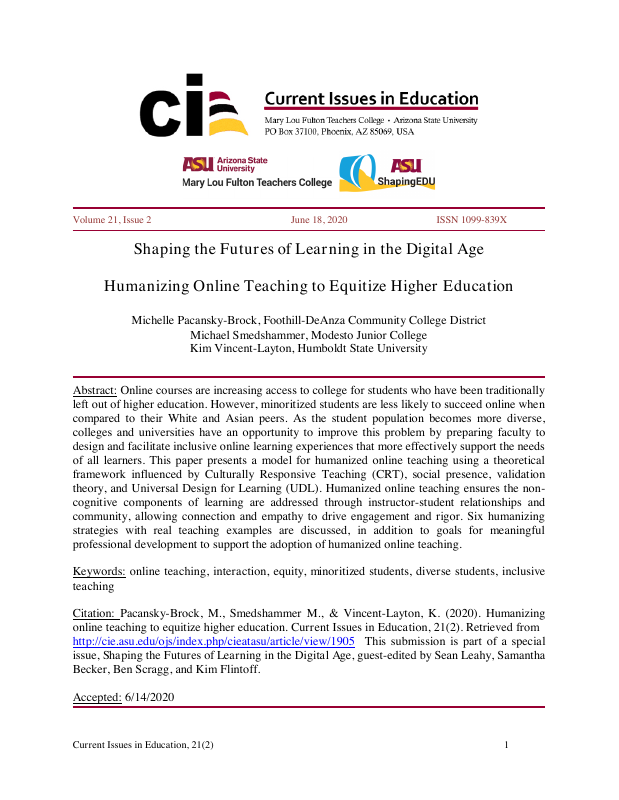
Humanizing Online Teaching to Equitize Higher Education

Current Issues in Education, 21(2)

A model for making online courses more inclusive through instructor-student relationships, community, and six practical teaching strategies.